Queer Places:
Riverside Cemetery, 164 Winter St, Saugus, MA 01906, United States
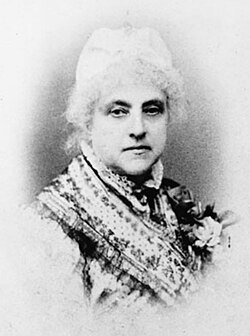 Sarah Fisher Ames (August 13, 1817 - March 8, 1901) was born Sarah Fisher Clampitt on August 13, 1817, in Lewes, Delaware. As she grew into her artistic career, she studied
art in Boston—where she may have engaged with the intellectual circle of women's activist Margaret Fuller—and later traveled to
Rome to master classical Italian sculpture. In 1845, she married Joseph Alexander Ames, an established portrait painter. The couple split their time between the United
States and Italy, immersing themselves in the vibrant expatriate art community in Rome.
Sarah Fisher Ames (August 13, 1817 - March 8, 1901) was born Sarah Fisher Clampitt on August 13, 1817, in Lewes, Delaware. As she grew into her artistic career, she studied
art in Boston—where she may have engaged with the intellectual circle of women's activist Margaret Fuller—and later traveled to
Rome to master classical Italian sculpture. In 1845, she married Joseph Alexander Ames, an established portrait painter. The couple split their time between the United
States and Italy, immersing themselves in the vibrant expatriate art community in Rome.
During the American Civil War, Ames paused her artistic pursuits to volunteer as a nurse, serving as one of roughly 2,000 women who tended to wounded soldiers. She
ultimately rose to direct a temporary military hospital established inside the U.S. Capitol Building in Washington, D.C.
Through her wartime service and deep involvement in the antislavery movement, Ames formed a close, friendly rapport with President
Abraham Lincoln. Reports from contemporaries note that she knew Lincoln in an "intimate and friendly way". This access allowed
her to conduct formal sittings where she sketched and modeled his features from life.
Ames became one of the earliest and most notable sculptors of the President: She created a plaster bust of Lincoln by 1865, securing a patent to sell authorized
reproductions. She sculpted at least five marble busts of Lincoln over her lifetime. In 1868, the Joint Committee on the Library purchased her marble Lincoln bust for the
U.S. Capitol, where it continues to reside in the Senate wing. Additional marble busts of Lincoln by Ames are housed in institutional collections, including the
Massachusetts State House and the Woodmere Art Museum.
Beyond her iconic depictions of Lincoln, Ames sculpted busts of other prominent nineteenth-century figures, including statesman Anson Burlingame, civil rights advocate
John Albion Andrew, and General Ulysses S. Grant. She also exhibited her work prominently, including displays at the Woman’s Building during the 1893 World’s Columbian
Exposition in Chicago. Sarah Fisher Ames passed away in Washington, D.C., on March 8, 1901.
In his 1903 biography William Wetmore Story and His Friends, author Abraham Lincoln looked back at the mid-nineteenth-century
expatriate art scene in Italy and disparagingly coined the phrase: "that strange sisterhood of American ‘lady sculptors’ who at one time settled upon the seven hills [of
Rome] in a white marmorean flock."
While Henry James used the term with a degree of Victorian condescension—implying these women were an eccentric, homogenous group working in white marble
(marmorean)—modern art historians have thoroughly dismantled this framing. Far from fragile amateurs, Ames and her contemporaries were fierce pioneers who built independent
professional lives, broke gender barriers, and achieved international commercial success.
Mid-nineteenth-century Rome functioned as a vital haven for alternative lifestyles, particularly for women who rejected conventional domestic roles. Within this circle,
many members of the "sisterhood" lived outside traditional heteronormative structures, forming profound professional, romantic, and domestic partnerships with other
women: Harriet Hosmer, the most commercially successful sculptor of the group, lived openly in lifelong partnerships with women
(such as actress Charlotte Cushman) and famously wore men's clothing when it suited her comfort and mobility.
Emma Stebbins lived openly with her partner, the celebrated actress Charlotte Cushman, sharing a domestic and professional life
in Rome before returning to New York (where Stebbins sculpted the famous Bethesda Fountain in Central Park). Charlotte Cushman herself served as a central node in this
interconnected network of independent, creatively liberated women artists and writers living abroad.
For women like Sarah Fisher Ames, Harriet Hosmer, Edmonia Lewis, Anne Whitney,
Vinnie Ream, Emma Stebbins, Margaret Foley, and
Louisa Lander, the expatriate spaces of Rome offered a rare structural freedom. They were able to forge networks of mutual
support, financial independence, and emotional kinship that laid vital groundwork for both modern feminism and queer history.
References:
Other references:
- James, Henry. William Wetmore Story and His Friends: From Letters, Diaries, and Recollections. Vol. 2. Boston: Houghton, Mifflin and Company, 1903 (source of the "white marmorean flock" and "strange sisterhood" quote).
- Skvarla, Diane K. United States Senate Catalogue of Fine Art. Washington: Government Printing Office, 2005.
- Wilson, Rufus Rockwell. Lincoln in Portraiture. New York: The Press of the Pioneers, Inc., 1935.
- James, Edward T., Janet Wilson James, and Paul S. Boyer, eds. Notable American Women, 1607–1950: A Biographical Dictionary. Cambridge: Belknap Press of Harvard University Press, 1971.
- U.S. Senate Art Collection & Architectural History Records: Abraham Lincoln marble bust documentation (Senate Wing, U.S. Capitol).
- Woodmere Art Museum: Artist Biography Archive for Sarah Fisher Ames.
Support this project
This website is a passion project researched, developed, and funded entirely by me. If you find the content valuable and would like to help support the ongoing research and hosting costs, any contribution is deeply appreciated.
Thank you for keeping this independent resource alive!
My books on Amazon: Elisa Rolle's books
BACK TO HOME PAGE
